

What Is the “Forbidden Guitar Chord”? The Fun Myth Explained
Updated: May 30
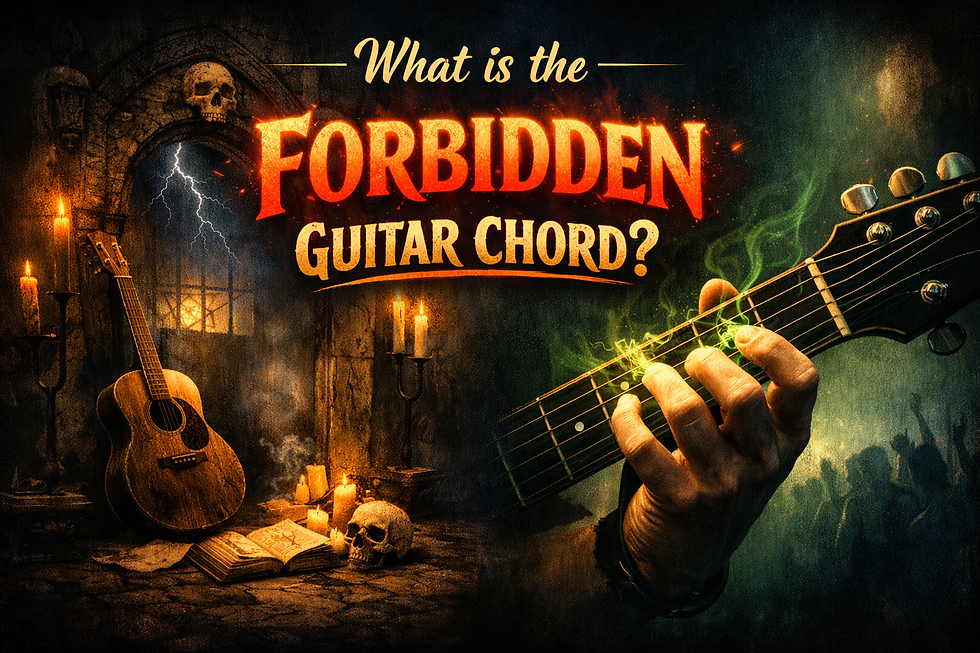
If you’ve spent any time around guitar players—especially beginners swapping stories online—you may have heard about the mysterious “forbidden guitar chord.” It sounds dramatic, like something out of a rock‑and‑roll legend, but the truth is much more fun and much less scary.
The “forbidden chord” isn’t actually banned. It’s not dangerous. And it’s definitely not off‑limits in your guitar lessons. Instead, it’s a playful nickname that musicians use to describe a chord that’s either difficult, dissonant, or famously overplayed.
Let’s break down what people really mean when they talk about the forbidden guitar chord—and why learning chords correctly is one of the best reasons to study with a professional guitar teacher who holds a Master’s degree in Classical Guitar Performance.
🎵 So… What Is the Forbidden Guitar Chord?
There are two common interpretations:
1. The “Devil’s Interval” (Tritone)
Historically, the tritone interval—also called diabolus in musica—was considered dissonant and unsettling. In medieval times, it was avoided in sacred music, which led to the myth that it was “forbidden.”
On guitar, this interval appears in chords like:
Diminished chords
Half‑diminished chords
Some altered dominant chords
These chords aren’t forbidden at all—they’re essential in jazz, classical, metal, and film music.
2. The “Forbidden Riff” Joke
In guitar stores, the real forbidden thing is playing the opening riff to “Stairway to Heaven.” It’s a long‑running joke among guitarists and shop employees because so many beginners play it (often not very well).
This joke sometimes gets misheard as “forbidden chord.”
🎓 Why Understanding Chords Matters — and Why a Highly Trained Teacher Helps
Chords are the foundation of guitar playing. But many beginners struggle with:
Buzzing strings
Muted notes
Awkward finger placement
Confusing chord shapes
Dissonant sounds they don’t understand
A teacher with a Master’s degree in Classical Guitar Performance brings a level of expertise that makes learning chords smoother, clearer, and far more enjoyable.
Here’s what advanced training gives you:
Precise technique that eliminates buzzing and strain
Clear explanations of harmony, intervals, and chord structure
Efficient fingerings that make difficult chords easier
A deeper understanding of tone and musicality
A structured path that builds confidence quickly
Instead of guessing why a chord sounds “wrong,” you’ll understand exactly what’s happening—and how to fix it.
🎸 Why Guitar Lessons Are Worth It When Learning Chords
Even simple chords can feel overwhelming without guidance. A professional instructor helps you:
Build correct hand position
Transition smoothly between chords
Understand why certain chords sound tense or dissonant
Learn advanced shapes like barre chords, diminished chords, and jazz voicings
Avoid bad habits that slow down progress
This is especially important for beginners who want to sound good quickly.
🌐 Learn in Memphis or Online — Same Great Instruction
Whether you’re in Memphis, TN or joining from anywhere online, you can study with a highly trained instructor who knows how to make chords feel approachable and musical.
Online lessons offer:
Flexible scheduling
High‑quality audio and video
Real‑time feedback
The same personalized instruction as in‑person lessons
Students love the convenience—and the results.
⭐ Final Thoughts: The Forbidden Chord Isn’t Really Forbidden
The “forbidden guitar chord” is more myth than reality—but it’s a great reminder of how rich and fascinating music theory can be. With the right teacher, even the most mysterious chords become understandable, playable, and fun.
If you want to build strong technique, learn chords the right way, and enjoy real progress, studying with a professional teacher who holds a Master’s degree in Classical Guitar Performance is one of the best decisions you can make.


Comments